Harry Powell–Marion Ruthven relationship
Young Captain Jack · The Son of a SoldierThe Harry Powell–Marion Ruthven relationship is a wartime romance shaped by an older family attachment and a new political division. Harry Powell returns to the Ruthven home as a Union surgeon, while Marion Ruthven remains attached to her Southern household and distrustful of the uniform he wears. Their affection survives that opposition, but the scenes between them make clear that private love is forced to negotiate the public loyalties of the American Civil War.
Reunion and Family Background
Harry Powell is introduced as a young surgeon attached to Colonel Stanton’s Federal regiment, which camps near the Ruthven home after the Confederate troops depart. He is a nephew of Mrs. Ruthven, and therefore Marion’s cousin, although Harry and the Ruthven family have not seen one another for years. He had gone North, established a medical practice in Philadelphia, and, because he was thoroughly opposed to slavery, joined the Federal troops when the war began. His decision horrifies his two aunts and Marion, while St. John Ruthven dismisses it as evidence that Harry has no practical sense.
The relationship therefore reopens across both time and ideology. Harry and Marion had cared deeply for one another as children, and their reunion restores feelings that had been dormant rather than extinguished. Marion blushes when they meet again; she dislikes the Union uniform, yet recognizes the manliness it represents in Harry. Her response is divided from the beginning: the political symbol repels her, while the person inside it retains the old emotional authority.
Their first renewed contact also establishes the relationship’s connection with the larger family crisis. When Harry calls to Jack Ruthven, Jack is startled to find a familiar relative in Federal uniform. Jack initially objects to Harry’s enlistment, but Harry asks whether Jack will at least greet him as a cousin, and Jack, who has always liked him, accepts the appeal. The exchange gives Harry and Marion a shared family ground on which affection can continue even while the war separates their convictions.
Affection under Political Strain
In their private conversation, Marion tells Harry that another danger threatens the household—not simply the presence of Union troops, but the stranger who wants to take Jack away. She describes Jack as practically her brother and says that her mother thinks of him as a son. Harry answers that he loves Jack as well and promises to do his best for Marion. His concern for Jack is thus not merely a courtesy to a cousin; it becomes one of the relationship’s central bonds and gives Harry a moral reason to remain involved in the Ruthven family’s danger.
Harry also confronts Marion about his absence and his decision to join the Union cause. He acknowledges that he had not understood the length of his separation until returning, then asks her forgiveness for having “gone over to the enemy.” Marion admits that she ought not to forgive him, but her hesitation reveals that her emotional judgment is already less severe than her political language. She can condemn the side he serves without severing the personal attachment formed before the war.
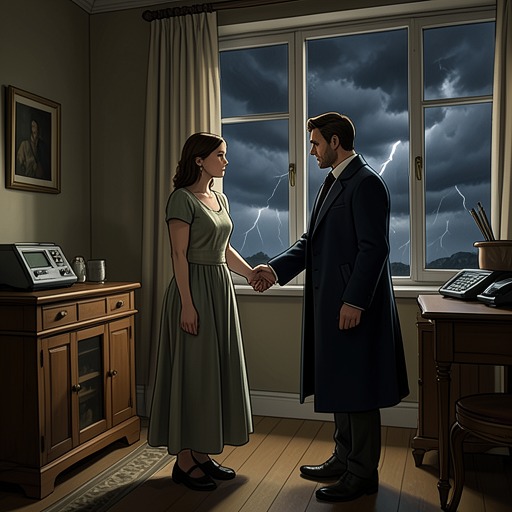
The conflict becomes more intimate when Harry tells Marion that he has always thought highly of her and always will, even though he has “turned Yankee.” Marion replies that he will remain dear to her as a cousin, carefully retreating into kinship language. Her answer preserves closeness while refusing to acknowledge a romantic commitment. The formulation is protective as well as evasive: it recognizes affection, but places it inside a relationship that the war cannot easily make treasonous.
Courtship and Resistance
Harry does not accept the safer definition of their bond. He presses Marion directly, declaring that the obstacle would arise only if the girl he has always loved abandoned him. When she points to his identity as a Yankee, he insists that his political allegiance does not alter his feelings. He then frames the issue as a moral question: whether a Southern girl should be unable to care for a man fighting according to his conscience. Marion does not deny his principles. Instead, she says that she honors him for adhering to them but asks that they speak no more about the subject for the present.
This exchange gives the romance its characteristic structure: Harry moves toward explicit declaration, while Marion withdraws into silence, family terminology, or postponement. Her resistance is not presented as indifference. She is visibly affected by him, remembers their earlier attachment, and struggles to reconcile admiration for his courage with her inherited hostility toward the Union. Harry, conversely, treats conscience as the ground on which love ought to stand rather than as a barrier that love must conceal.
The relationship’s immediate circumstances intensify that hesitation. St. John Ruthven approaches as Harry and Marion discuss their feelings, forcing Harry to release Marion’s hands and move to the other side of the summerhouse. The interruption converts a private courtship into a guarded encounter and reminds both characters that the Ruthven household contains competing interests, surveillance, and danger. Their love can be spoken only in fragments, and even those fragments are vulnerable to interruption.
The Relationship’s Wider Meaning
Harry and Marion’s romance is inseparable from Harry’s loyalty to Jack Ruthven. Marion seeks Harry’s protection for the brother her family adopted, while Harry presents his love for Jack as another expression of family belonging. In this sense, the courtship does not stand apart from the novel’s identity plot: it tests whether kinship can be preserved through affection and obligation even when blood, adoption, war, and property create rival definitions of family.
The relationship also offers a personal version of the book’s larger North–South tension. Marion begins by treating Harry’s uniform as a moral and regional offense, whereas Harry refuses to reduce either his principles or his love to a mere sectional label. Their encounter does not erase the war, and the supplied scenes do not record a final marriage or completed romantic resolution. What they do establish is a durable emotional bond under pressure: childhood affection returns, political disagreement produces hesitation, Harry openly renews his claim, and Marion, while refusing an immediate answer, continues to acknowledge him as someone deeply dear to her.